

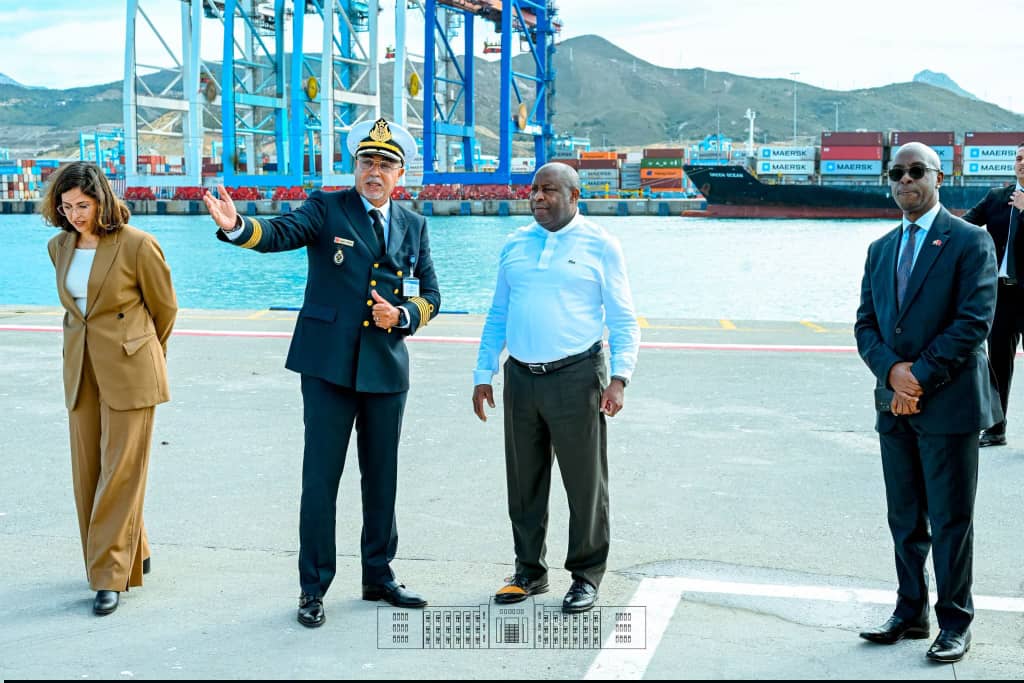
A guided tour at the heart of Africa’s leading port
As part of his visit to Morocco, the President of the Republic of Burundi, His Excellency Évariste Ndayishimiye, who is also the serving President of the African Union, took a guided tour of the Tanger Med port complex, one of the main maritime and logistics hubs of international trade. Welcomed and accompanied by the port’s Commander, Mr Kamal Lakhmass, the Burundian head of state was able to appreciate the scale of the infrastructure, the port’s operational capacities and its strategic role in trade between Africa, Europe and the rest of the world.
A complex with impressive infrastructure
During the detailed presentation given to him, President Ndayishimiye was briefed on how the port complex operates, its performance, its development prospects and the factors underpinning its competitiveness on the international stage. Tanger Med has four container terminals, a terminal dedicated to hydrocarbons, facilities for general cargo and vehicles, as well as a port reserved for passengers and ro-ro vessels. All of this infrastructure covers about 1,000 hectares and is connected to road, rail and motorway networks.
The Burundian head of state was also informed of the importance of the goods passing through this port: industrial and agri-food products, vehicles, hydrocarbons, raw materials and other goods carried in containers. These activities make Tanger Med an essential platform for imports, exports and the transhipment of goods.
A major contribution to the Moroccan economy
On the economic front, the head of the port stressed Tanger Med’s major contribution to the national economy. Its activities generate around 15% of Morocco’s Gross Domestic Product (GDP). Mr Kamal Lakhmass also highlighted the dynamism of the Moroccan automotive industry, which has reached a production rate of one vehicle every thirty seconds. These performances illustrate the returns on investment in infrastructure, logistics and industrialisation, as well as the synergies between port activities and the Kingdom’s industrial development.
World-class performance
In terms of performance, the port complex handled more than 11.1 million TEU containers in 2025. It ranks first in Africa and the Mediterranean for container traffic and is among the world’s top twenty ports in this field. It is also recognised for its operational efficiency and its capacity to host the major international shipping lines.
Its geographical position is one of its main assets. Located close to the Strait of Gibraltar, at the crossroads of the major sea routes linking the Atlantic to the Mediterranean, the port serves some 180 ports spread across 70 countries. This openness allows it to act as a strategic gateway for international trade.
An inspiring experience for Africa
The visit also allowed the Burundian President to appreciate the port facilities and their exceptional geographical setting. From the site, he was able to look directly out over the Strait of Gibraltar and the Spanish coast, visible on the opposite shore, illustrating the proximity between the two continents and the importance of this sea route in economic relations between Africa and Europe.
This visit thus allowed the Head of State to better grasp the Moroccan experience in developing port infrastructure, logistics, international connectivity and trade facilitation. These are all areas that hold an important place in strategies for economic development and regional integration, particularly for a landlocked country like Burundi, which depends on its neighbours’ logistics corridors for its trade with the world.
A lesson in development worth pondering
By discovering Tanger Med, President Ndayishimiye was able to gauge how far Morocco has come in infrastructure and logistics. This port, which has transformed the economic face of the Kingdom and enabled it to establish itself as an emerging nation, is an eloquent example for the entire continent. The Burundian head of state, who himself hailed in Tanger “a model” for Africa, leaves with valuable lessons for his country and for the African Union. For development requires modern infrastructure, increased connectivity and a long-term strategic vision. Morocco has understood this. And its experience deserves to be shared, studied and adapted by the continent’s other nations, in a spirit of South-South cooperation and shared prosperity.