

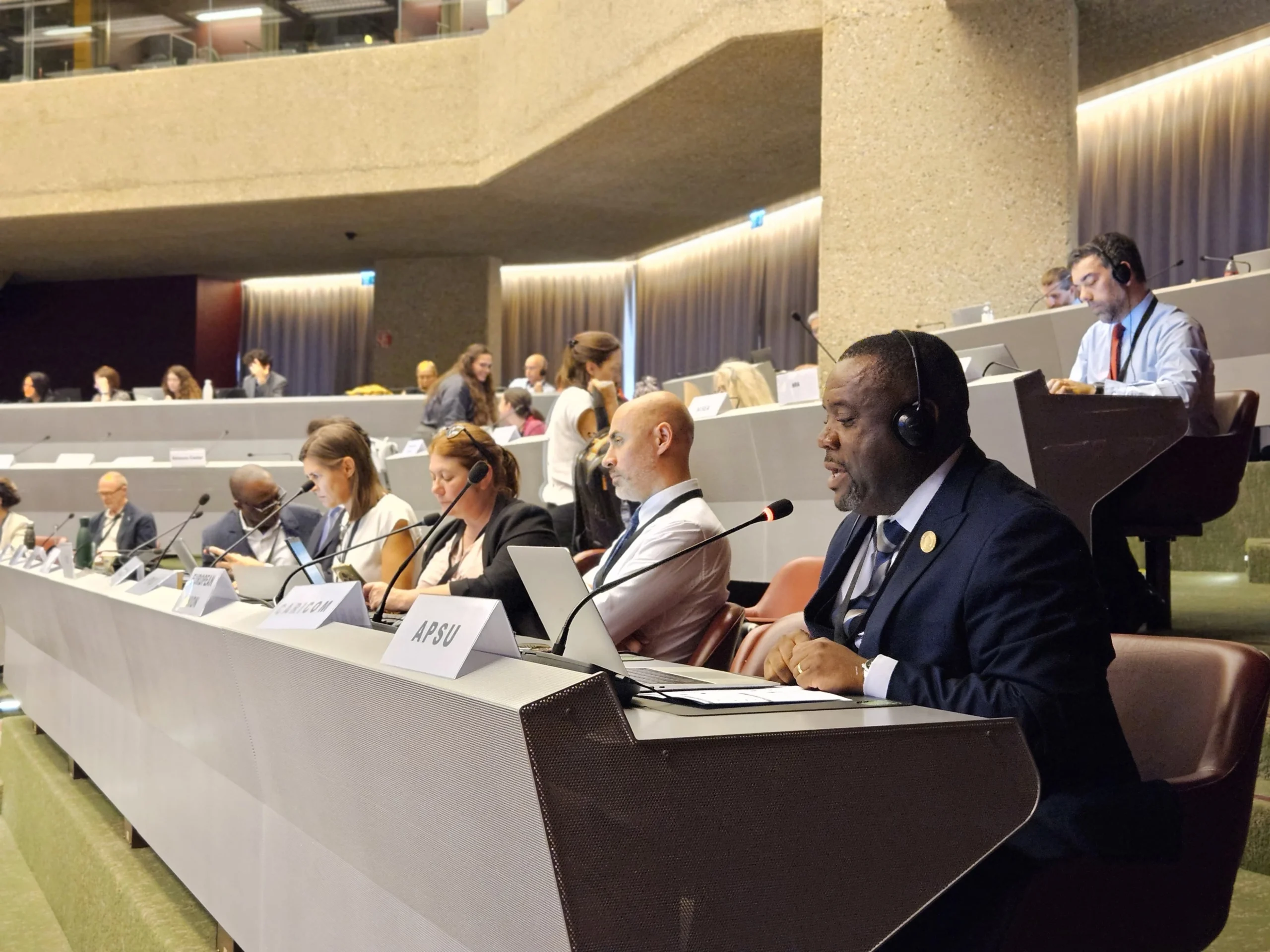
The call on African countries to sign, ratify and domesticate the United Nations Arms Trade Treaty was the key message of diplomat Roll Stéphane NGOMAT, President of the African Peace and Security Union (APSU), at the Twelfth Conference of States Parties (CSP12) to the Arms Trade Treaty (ATT).
The conference, held in Geneva, Switzerland, from 24 to 28 August 2026, is a high-level international meeting bringing together diplomats and state representatives to discuss the conflicts and armed violence fuelled by the illicit proliferation of small arms and light weapons (SALW) and by the unregulated flows of arms and ammunition that continue to plague the world.
In his address, the Gabonese diplomat urged African States to fully incorporate all the provisions of the Arms Trade Treaty into their national legislation. He also stressed that combating the illicit proliferation of small arms and light weapons requires greater and better-coordinated involvement from state actors, the private sector and the international community in order to achieve lasting peace and prosperity.
Mr Ngomat said: "It is urgent that States Parties take full ownership of the Arms Trade Treaty, assume responsibility for it and devote the financial resources needed for effective implementation. States Parties that do not have national action plans relating to the Treaty should adopt them swiftly, while those that already have them should implement them without delay and in good faith. States Parties, he added, must take concrete steps to make local ownership and implementation of the Arms Trade Treaty a national priority, by integrating it into their legal frameworks, policies, programmes and national budgets."
The diplomat believes that armed conflicts are complex, dynamic and multifaceted phenomena with serious negative repercussions, both direct and indirect, on the nations affected. He went on to add that global coordination is needed to stem the illicit flows that fuel conflict, organised crime and population displacement, from Haiti to the Sahel. "The illicit trade in and diversion of small arms and light weapons fuel armed violence, terrorism and organised crime, thereby perpetuating conflicts, terrorism and criminal networks in many regions," he said.
He explained that it is weapons diverted from national stockpiles, or at any stage of the supply chain, that most often end up in the hands of non-state armed groups. The human toll is tragic.
In 2024, the United Nations recorded at least 48,000 conflict-related civilian deaths, with small arms responsible for nearly 30% of those deaths in certain contexts.
In 2026, global data on illicit weapons highlight the growing challenges posed by trafficking in small arms and light weapons (SALW), prompting new data-collection initiatives in regions such as Nigeria, where a new baseline survey has been announced to replace the outdated 2016 figures, and the presentation of new EU legislative proposals aimed at combating cross-border trafficking and standardising seizure databases.
The European Commission has also put forward a comprehensive draft directive seeking to harmonise criminal definitions, penalties and mandatory recording standards for seizure data across Member States.
The Arms Trade Treaty (ATT) is an international treaty that regulates the international trade in conventional arms and aims to prevent and eradicate the illicit trade in and diversion of conventional arms by establishing international standards governing arms transfers.
The Arms Trade Treaty (ATT) entered into force on 24 December 2014. To date, 118 States are parties to the Treaty and 25 States have signed it without yet having ratified it.
Roll Stéphane Ngomat is a Gabonese diplomat, an expert in international relations and a committed advocate of peace, security and sustainable development in Africa. Drawing on his experience in peace and security diplomacy in Africa, he has devoted his career to promoting regional cooperation, strengthening African institutions and developing international partnerships. Throughout his career, Roll Stéphane Ngomat has contributed to initiatives aimed at strengthening governance, promoting peace and security, empowering young people and women leaders, and encouraging sustainable development in Africa. Carried out in collaboration with governments, continental institutions, civil society organisations and international partners, these initiatives reflect a shared commitment to advancing African solutions to the continent’s challenges.