

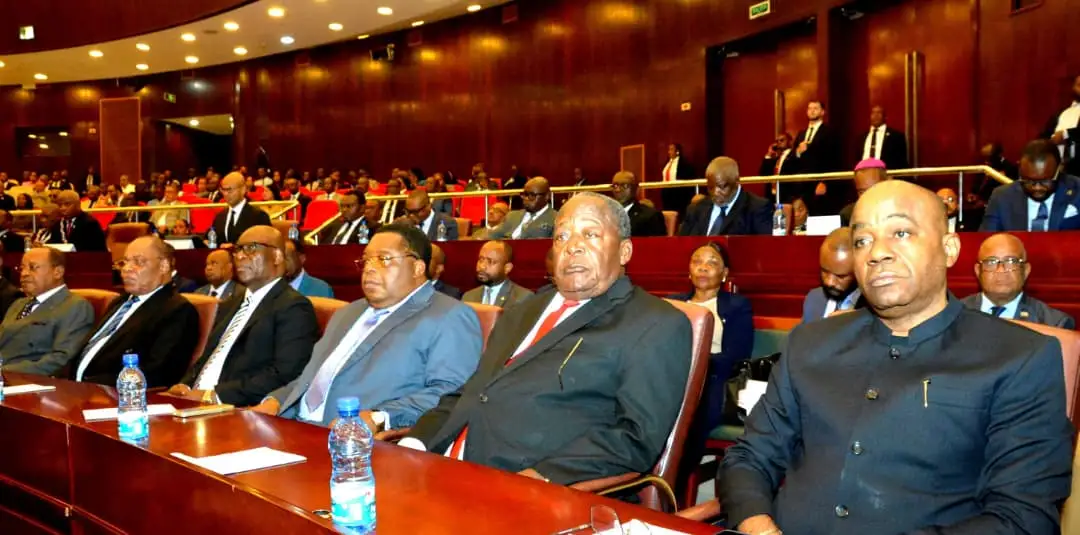
A solemn ceremony marked by national unity
The President of the Republic, His Excellency Obiang Nguema Mbasogo, presided over the solemn closing ceremony of the first parliamentary session period on Friday, May 29. The ceremony was attended by the Vice President of the Republic in charge of State Defense and Security, His Excellency Teodoro Nguema Obiang Mangue, members of the Chamber of Deputies and the Senate, presidents of constitutional bodies, the Prime Minister, as well as civil and military authorities. The PDGE was represented by its Secretary-General, Faustino Ndong Esono Eyang, accompanied by the First Deputy Secretary-General, Armando Ela Nsue Mengue, and the Second Deputy Secretary-General, Judith Nfono Ngomo Nchama.
A rich and diverse legislative record
The ceremony featured speeches by the Second President of the Senate, Agustín Nze Nfumu, and the President of the Chamber of Deputies, Salomon Nguema Owono. Both parliamentary leaders thanked the founding President of the PDGE for his continuous support to legislative institutions. They also highlighted the significance of the historic pastoral visit of His Holiness Pope Leo XIV to Equatorial Guinea, an event that left a lasting impression and strengthened ties between the nation and the Holy See.
During the four months of parliamentary work, both chambers examined and approved major legislative initiatives relating to labor, public finance, transparency, social protection, the comprehensive education system, the criminalization of genocide, the establishment of the Obiang Nguema Mbasogo National University, the creation of the National Deanery, and the expansion of the territorial boundaries of the province of Djibloho, among other measures aimed at strengthening institutions and promoting national development.
The Head of State congratulates the Equatorial Guinean people on the Pope’s visit
In his address, President Obiang Nguema Mbasogo congratulated the constitutional bodies, the Government, security forces, protocol services, political and religious authorities, and the Equatorial Guinean people for the successful visit of the Holy Father.
"During this event, we demonstrated the spirit of solidarity, civic responsibility, and patriotism of our people, and above all, the democratic reality of Equatorial Guinea and the peace our country enjoys," the Head of State declared.
Fight against corruption and judicial reform
The President also commended Parliament for its achievements during the legislative period and for its efforts to strengthen the State’s budgetary balance. He emphasized that no nation can be strong without a solid economy capable of meeting development challenges and supporting the gradual relocation of public administration to the City of Peace.
In this context, he called for continued efforts to combat corruption practices that hinder sustainable development and praised the reforms undertaken within the judicial system to modernize its operations and consolidate the rule of law.
"It is imperative that the people of Equatorial Guinea benefit from an independent and efficient justice system that serves their rights and freedoms," he stated.
Four new senators take office
During the ceremony, four new senators from the districts of Cogo, Malabo, Mongomo, and Ebibeyin took the oath of office before the Head of State. Their appointment reflects the dynamism of the country’s parliamentary institutions and the commitment to renewing the national political class.
Looking toward the future
President Obiang Nguema Mbasogo also reviewed the legislative progress and transformation process experienced by Equatorial Guinea over recent decades, emphasizing the fundamental role of Parliament in the country’s institutional consolidation. He reaffirmed his commitment to continuing the construction of a modern, strong, prosperous nation oriented toward a future filled with hope.
A productive parliamentary session for institutional strengthening
The conclusion of this first parliamentary session period marks an important milestone in Equatorial Guinea’s institutional life. Through the adoption of key legislation, the fight against corruption, and judicial reform, the country continues its path toward modernization and the strengthening of the rule of law under the leadership of a Head of State who has consistently placed stability and progress at the center of his action.