

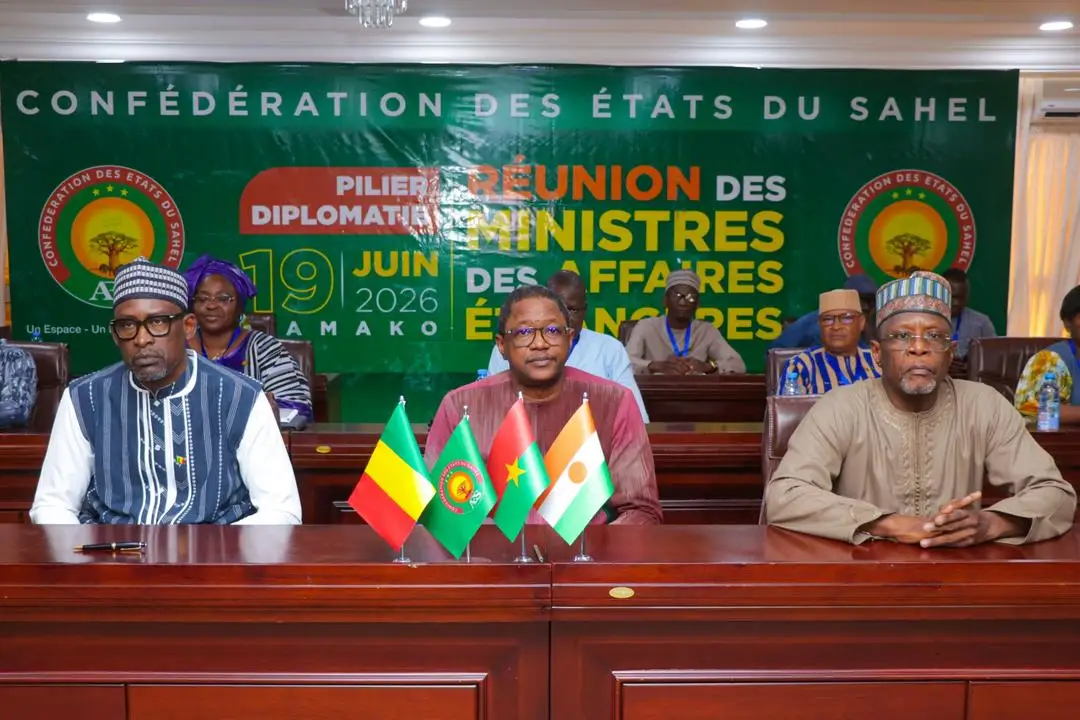
Bamako has become the symbol of a new Sahelian diplomatic offensive. Meeting on June 20, 2026, in the Malian capital, the Foreign Ministers of Burkina Faso, Mali, and Niger made their intentions clear: to transform the Confederation of Sahel States (AES) into a regional power capable of defending its interests independently of traditional centers of influence.
Behind the official statements lies a broader political project aimed at redefining power dynamics in West Africa and beyond.
One Voice for Three States
Since distancing themselves from traditional regional cooperation frameworks, the three AES countries have multiplied efforts to build their own governance architecture. In Bamako, the ministers took another step forward by agreeing to strengthen diplomatic coordination among their states.
Their ambition is significant: harmonize positions on major international issues, coordinate diplomatic representations, and speak with a single voice within international organizations.
This strategy is intended to increase the political weight of the AES in global negotiations while reinforcing a vision of sovereignty that its leaders describe as non-negotiable.
AES Confronts What It Sees as External Threats
The tone of the communiqué was unequivocal. The ministers denounced attempts to destabilize the three confederated states and accused foreign actors of indirectly supporting actions designed to slow the progress of the AES.
Recent security incidents in Mali and Niger were cited as examples of the persistent pressure facing the Confederation. Authorities in the three countries argue that terrorist attacks are not merely security threats but also tools used to undermine their common political project.
In response, the AES reaffirmed its determination to strengthen security cooperation and protect its model of governance.
The Information Battle Becomes a Strategic Front
Beyond military and diplomatic concerns, the Confederation now identifies information warfare as another major arena of confrontation.
The ministers denounced what they described as disinformation campaigns targeting both their states and the Confederation itself. To address this challenge, they announced plans to strengthen cooperation among the communication structures of the three countries.
This decision reflects a growing awareness that in today’s world, the battle for public perception is becoming just as important as military, political, or economic struggles.
An Organization Reaching Maturity
Several years after the first political convergence between Bamako, Ouagadougou, and Niamey, the AES appears to be entering a new phase of development.
Institutional progress, the ratification of common legal instruments, and growing diplomatic coordination demonstrate a clear commitment to establishing the Confederation as a lasting force within the African political landscape.
For its leaders, the objective now goes beyond simple cooperation among neighboring states. It is about building an integrated political space capable of defending Sahelian interests in an increasingly competitive international environment.
The Sovereignty Bet
In Bamako, the ministers reaffirmed their commitment to pursuing the vision championed by Presidents Ibrahim Traoré, Assimi Goïta, and Abdourahamane Tiani: building a space founded on sovereignty, security, and shared prosperity.
Whether this ambition will translate into tangible benefits for citizens remains to be seen. One thing, however, is certain: the AES no longer wishes to be viewed as merely a regional actor. It now aspires to become a political and diplomatic force capable of shaping the future balance of power across Africa.
As the Confederation strengthens its institutions, its message grows increasingly clear: the Sahel intends to write its own future.