

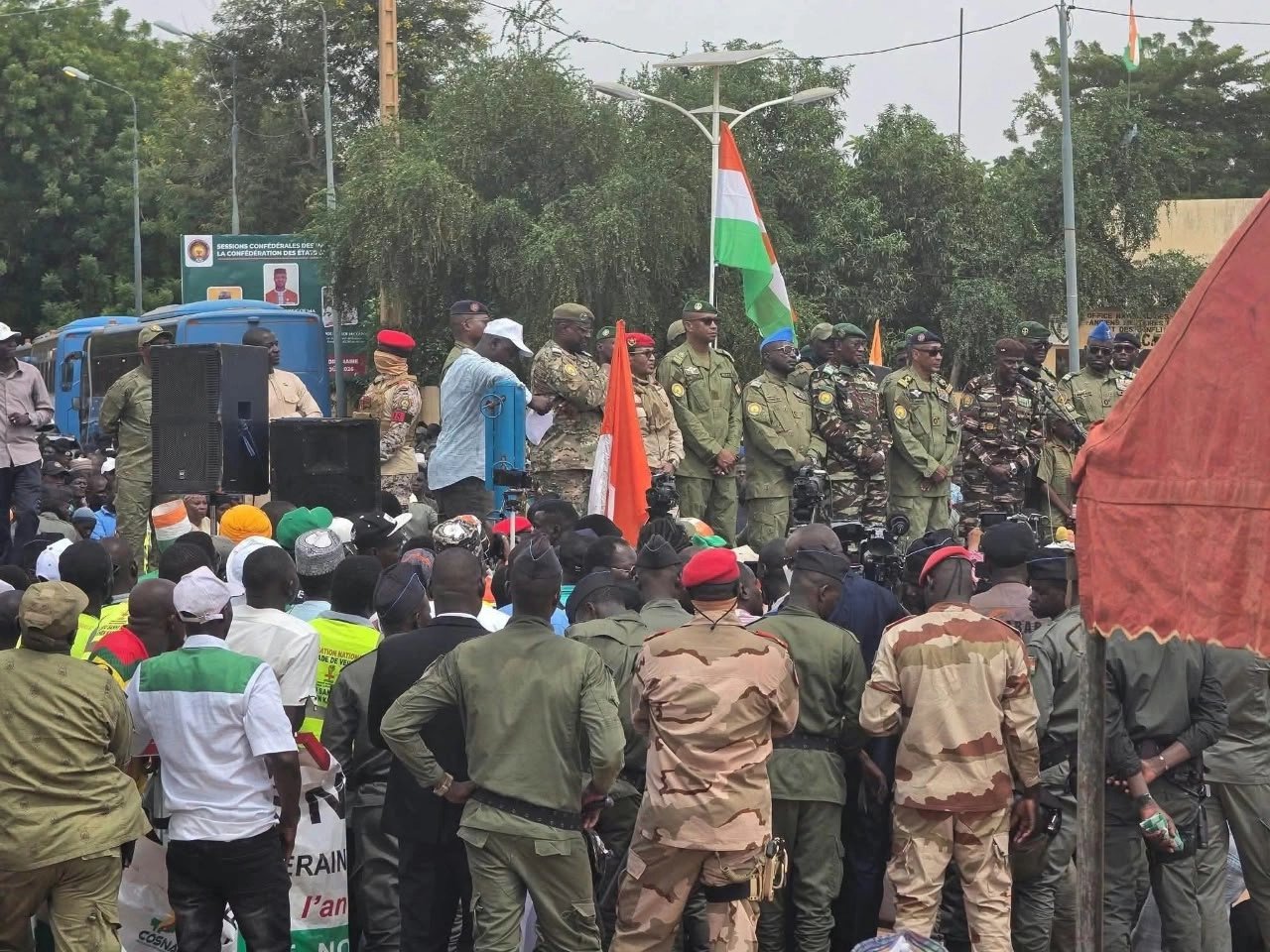
As Niamey says it thwarted an attempted seizure of power on August 28 and 29, statements by an officer from the 1st Paratrooper Battalion are fueling regional tensions. Several of his allegations against neighboring countries, however, remain unsubstantiated and raise questions about their scope and reliability.
Niamey — The attempted mutiny that shook the Nigerien capital on the night of August 28–29 continues to reveal unanswered questions. Mutinous soldiers attacked strategic facilities, including Base 101 at Diori-Hamani International Airport and sites linked to the presidency. Forces loyal to the authorities eventually regained control of the situation.
In the days that followed, statements by Captain Roger Gabriel, a company commander within the 1st Paratrooper Battalion, gave the affair a new dimension. In a recording broadcast by Niger’s Radio and Television network, the officer said he had been informed of several elements relating to the events and referred in particular to alleged internal and external accomplices.
But beyond the seriousness of these allegations, one central question remains: what material evidence is available to substantiate them?
Regional Allegations That Require Evidence
Captain Roger Gabriel reportedly referred to the alleged involvement of several foreign states, including Benin, Côte d’Ivoire, Chad and France. If established, these claims could have considerable consequences for relations that are already fragile between Sahelian states and their neighbors.
For now, caution is required. An allegation made by a protagonist in a military crisis does not, by itself, constitute proof of a state’s involvement.
The case of Benin is particularly revealing. Publicly available timelines of President Romuald Wadagni’s movements around August 25–27 place him in northern Benin. On August 25, he was in Nikki for Gaani 2026, where he was received by Emperor Séro Torou. On August 26 and 27, Beninese sources also reported his presence in Parakou and his activities in the northern part of the country.
This timeline therefore deserves to be compared with the statements attributed to Captain Gabriel. It does not, on its own, establish anyone’s innocence or guilt, but it demonstrates the importance of carefully verifying dates, locations and movements before drawing conclusions.
A Testimony at the Heart of a Battle of Narratives
Another question concerns Captain Roger Gabriel’s exact role in the events.
In his testimony, the officer says he did not participate in the action launched at Base 101. He explains that he was awakened by gunfire, alerted his chain of command, and was then ordered to issue weapons to his men in order to secure his camp. He subsequently says he was tasked with securing the second bridge.
This account will naturally have to be compared with the testimonies of other soldiers, recorded communications, the movements of military units and any material seized as part of the investigation.
It would therefore be premature to portray the captain as one of the coup’s masterminds or to claim that he intended to replace General Abdourahamane Tiani without judicial evidence establishing such facts.
The essential question is not only what he claims, but what the investigations will ultimately demonstrate.
A Crisis First and Foremost Military and Political in Nature
One point nevertheless emerges from the initial information available: the attempted coup unfolded within Niger’s own military apparatus.
The mutineers and loyalist forces belong to the Nigerien armed forces. The fighting and clashes pitted Nigerien soldiers against one another around strategic installations in the capital. International sources have also described the unrest as being linked, among other things, to security difficulties and the pressure exerted on the armed forces by jihadist groups.
This internal dimension obviously does not rule out the possibility of external support or intermediaries. But any such involvement must be demonstrated through independent evidence: communications, financial transfers, operational orders, documented movements or corroborating testimony.
Without such evidence, accusations against foreign governments risk turning an internal military crisis into a regional diplomatic crisis.
The Danger of Diplomatic Escalation
In an already deeply fragmented Sahel, any accusation directed against a neighboring state can quickly acquire a geopolitical dimension.
Niger, Mali and Burkina Faso have chosen to strengthen their cooperation within the Alliance of Sahel States, while their relations with several regional and Western partners have deteriorated sharply since the changes of regime in these countries.
In this context, attributing an attempted destabilization to neighboring states without evidence could further aggravate tensions and make security cooperation even more difficult.
The responsibility of Nigerien authorities is therefore considerable: establish the facts without turning allegations into verdicts before the investigations are complete.
The Time for Evidence
The attempted seizure of power on August 28 and 29 is serious enough to require a comprehensive investigation.
The role of each military figure involved must be established. Individual responsibilities must be determined. Any alleged accomplices must be documented. And if foreign actors genuinely participated in a destabilization operation, the evidence proving such involvement must be presented.
The reverse is equally true: if some allegations prove unfounded, they must be clearly distinguished from established facts.
Niger would gain nothing by replacing investigations with a battle of narratives and suspicions.
Between Judicial Truth and Political Battles
Captain Roger Gabriel’s statements have undeniably revived the debate over the circumstances surrounding the attempted coup. They provide avenues for investigation, but cannot by themselves constitute the conclusion of the case.
The real challenge now is to determine, on the basis of evidence, who planned the mutiny, who carried it out, who may have supported it and for what purpose.
Nigerien justice will have to answer these questions rigorously.
Because beyond the fate of the soldiers involved, the stability of Niger and that of the entire sub-region are at stake. In such an explosive context, unverified allegations can be as destabilizing as the events they claim to explain.
One thing is certain: in this case, the truth cannot rest solely on the statements of a single officer. It must be reconstructed from facts, evidence and an investigation capable of withstanding political and diplomatic pressure.